
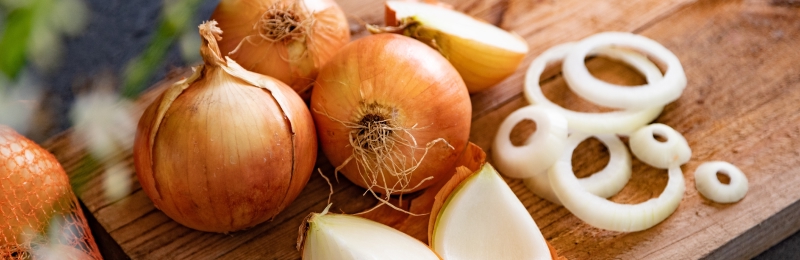
About Onions
Onion sets are small, dormant onion bulbs grown during their first year and harvested for replanting the following season. Once planted, they resume growth quickly in cool weather,
Onion sets are small, dormant first-year onion bulbs grown the previous season. When planted, they enter their second year of growth, quickly producing leafy tops in cool weather, developing roots and foliage before forming bulbs as daylight hours increase.
Long-day onions require 14 to 16 hours of daylight to form bulbs and are best suited for the northern half of the United States (USDA Zones 3 through 7/8). For our southern gardeners, long-day onion sets can be grown for scallions or bunching onions.
Intermediate-day (or day-neutral) onions form bulbs in a variety of zones, but are especially suited for gardeners in zones 5 and 6 throughout the central US. They need 12 to 14 hours of daylight and can be used for both scallions and bulbs, typically maturing in two to three months. These onions also form bulbs in the warmer USDA Zones 8 and above.
Onion sets are cold tolerant, easy to plant, and mature earlier than onions grown from seed or transplants, making them a reliable choice for many gardeners.
When to Plant Onion Sets
Long-Day Onions
Plant long-day onion sets as early as the soil can be worked. Cool temperatures are necessary for root development before bulbing begins.
By USDA Zone:
- Zones 3–4: Late March–April
- Zones 5–6: Early–mid March
- Zone 7: Late February–early March
- Zone 8: Best grown for scallions or small bulbs
- Zones 9–10: Best grown for scallions or small bulbs
Soil temperatures should be above 40 to 45°F at planting. Early planting results in larger bulbs, while late planting can lead to reduced bulb size.
Intermediate-Day or Day-Neutral Onions
Plant intermediate-day onions in spring for a late-summer crop. Bulb formation is initiated when day length reaches 12 to 14 hours.
By USDA Zone:
Zones 9 & 10: February–March
Zones 3–4: Mid April–Early May
Zones 5–6: Late March–April
Zone 7 & 8: Late February–early March
Where to Plant Onion Sets
Choose a full sun that provides at least six to eight hours of direct sunlight daily. Insufficient sunlight results in smaller bulbs.
Onions perform best in loose, fertile, well-drained soil that allows their shallow roots to develop easily. Ideal soil has a pH between 6.0 and 6.8 and a loam or sandy loam texture. Soils rich in organic matter with excellent drainage promote healthy growth and help prevent rot and poorly formed bulbs.
Avoid heavy clay soils without amendment and do not use fresh manure. Prior to planting, incorporate two to three inches of compost and apply a balanced fertilizer or phosphorus-forward blend.
How to Plant Onion Sets
Before planting, loosen the soil to a depth of six to eight inches to encourage strong root growth. Plant onion sets about one inch deep, spacing them three inches apart with 12 to 18 inches between rows. If you would like to harvest some as green onions, plant them one-and-a-half inches apart and pull every other one as a scallion, leaving the others to mature into larger onions. Set each bulb with the pointed end facing up and the basal plate down, then cover lightly with soil and water thoroughly to settle the soil around the bulbs.
Provide consistent moisture without oversaturating the soil. Supply approximately one inch of water per week early in the season, increasing slightly during bulbing. Reduce watering once tops begin to fall over.
Apply nitrogen early in the season to encourage leaf growth. Discontinue nitrogen once bulbs begin to swell to prevent excessive foliage growth.
Mulch with straw, shredded leaves, or pine needles to conserve moisture and suppress weeds. Keep mulch from contacting bulb tops directly.
How to Care for Onions
Harvest when 50% to 80% of the tops have naturally fallen over, indicating that bulbs have finished developing.
If the weather is dry, allow bulbs to remain in the garden for seven to ten days. Cure onions in a dry, shaded area with good airflow for two to four weeks.
Storage Life (Properly Cured):
- White Ebenezer: 10–12 months
- Yellow Stuttgarter: 10–12+ months
Red Karmen: 4–6 months
Southern Growing Note
In regions below approximately latitude 35° (Zones 8 thru 10), long-day onion varieties produce leafy growth but only small bulbs. In these areas, onion sets are best grown for scallions or bunching onions.