
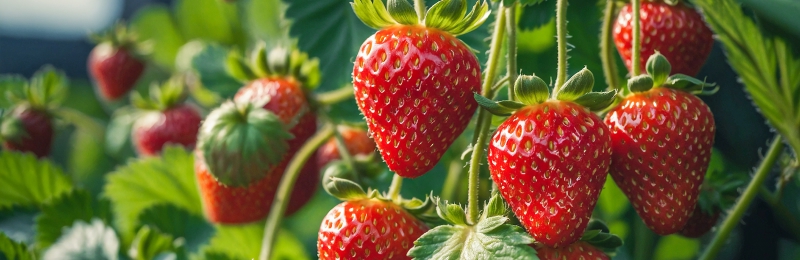
About Strawberries
Strawberries are perennial plants grown from bare-root crowns, not roots alone. The crown is the swollen, living stem where all new leaves, roots, runners, and flower trusses originate. Proper crown placement and early care are essential for plant survival, berry size, and long-term productivity.
Strawberries are commonly grouped into three types, each with distinct growth and fruiting habits:
Junebearing strawberries produce one large crop in late spring or early summer and offer the highest yields and largest berries. They form flower buds in fall, overwinter in a dormant state, and produce a heavy harvest the following spring.
Everbearing strawberries produce two to three smaller harvests throughout the season, typically in late spring, midsummer, and early fall. They provide a steady supply of fruit with moderate runner production.
Day-neutral strawberries produce flowers and fruit continuously whenever temperatures remain between 40°F and 85°F. These modern hybrids have minimal runner production and are well suited for containers and extended growing seasons.
When to Plant Strawberry Roots
Strawberry crowns should be planted as soon as the soil can be worked in spring, once soil temperatures reach 45°F to 50°F. Cool soil and mild weather allow crowns to establish strong root systems before flowering and fruiting.
Planting by USDA zone:
- Zones 3 & 4: April–May
- Zones 5 & 6: March–April
- Zone 7: February–March
- Zones 8 through 10: January–February
In Zones 7 through 10, strawberry crowns may also be planted in early fall (September through October). Fall planting results in stronger crowns, improved bud formation, and larger first-year harvests.
Where to Plant Strawberry Roots
Strawberries require full sun to produce high yields and flavorful fruit. Plants should receive at least six hours of direct sunlight per day, with 8 to 12 hours preferred, especially morning sun, which helps dry foliage quickly and reduces disease pressure.
Choose a planting site with loose, fertile, well-drained soil that is rich in organic matter. Strawberries perform best in soil with a pH between 6.0 and 6.8 and a loam or sandy loam texture. Because strawberries have shallow root systems and a low tolerance for compaction or standing water, excellent drainage is essential. Raised beds or mounded rows are strongly recommended, particularly in heavier soils.
Poorly drained soil can lead to crown rot, root disease, and overall decline in plant vigor. Before planting, improve soil structure by incorporating two to three inches of compost and applying a balanced fertilizer such as 5-10-10 or 10-10-10. Avoid using fresh manure, planting in poorly amended clay soils, or growing strawberries in highly alkaline conditions.
How to Plant Strawberry Roots
Before planting, soak strawberry bare roots in lukewarm water for 10 to 20 minutes to rehydrate them. Do not soak longer, as prolonged soaking can damage the roots.
Dig a shallow hole and spread the roots outward like a fan, allowing them to sit naturally in the soil. Avoid twisting, bending, or bunching the roots, since strawberries develop new feeder roots at the base of the crown and along shallow lateral roots. Proper root placement encourages quick establishment and strong growth.
Crown placement is critical to plant survival. The roots should be fully below the soil surface, while the crown itself must sit level with the soil line. Burying the crown can cause rot, and leaving roots exposed will result in plant failure.
Keep the soil consistently moist during the first four to six weeks while plants establish, taking care not to oversaturate the soil. Once established, strawberries require one to two inches of water per week, applied early in the day to help reduce disease pressure.
Apply mulch immediately after planting using clean straw, shredded leaves, pine needles, bark fines, or landscape fabric topped with compost. Mulching conserves moisture, suppresses weeds, and protects crowns from both heat and cold.
Space plants according to the growing method. In-ground beds should be planted 12 to 18 inches apart, with 18 to 36 inches between rows. In raised beds, space plants 12 to 14 inches apart. For containers, plant one strawberry crown per 10 to 12 inch pot, with additional spacing in towers or vertical systems.
After planting, firm the soil gently around the roots and water thoroughly to settle the soil.
Important Early Care
For best long-term productivity, remove early flowers according to strawberry type. Junebearing strawberries should have all flowers removed for the first four to six weeks after planting. Everbearing and day-neutral varieties should have all flowers removed for two to three weeks and most runners should be removed to direct energy into fruit production rather than vegetative growth.
Harvesting Strawberries
Strawberries are ready to harvest when berries are fully red, firm, and glossy. It’s important to note that strawberries do not continue to ripen after picking, so harvest at peak color for best flavor.
Pick berries regularly to encourage continued production and prevent overripe fruit from attracting pests. Harvest with a short stem attached to avoid damaging the plant.
Junebearing strawberries produce a single heavy harvest over a two to four week period, while everbearing and day-neutral varieties produce fruit intermittently throughout the growing season.
With proper care, strawberry plants can remain productive for several years, especially when runners are managed and beds are renewed as needed. To maintain top quality and a large yield, we recommend the bed be replaced every two years.